However, risks to the outlook stems from possible sub-normal monsoon and higher crude oil prices (on account of the crisis in Iraq)," the Economic Survey 2013-14 tabled in Parliament by Finance Minister Arun Jaitley said.
TCS, Wipro and Infosys dropped by up to 4.47 per cent, dragging down the BSE IT index by 2.96 per cent
The government on Monday said that matters regarding Chinese intrusion can't be discussed in Parliament as it concerns the security of the country.

The government should frame new policies to assure growth.

The first session of 17th Lok Sabha will commence on Monday, which will see the passing of the Union Budget and some key legislations like triple talaq bill being on top of the government agenda.

Equity benchmarks climbed in early trade on Wednesday amid an overall positive trend in the global markets and ahead of the presentation of Union Budget 2023-24. The 30-share BSE benchmark Sensex jumped 516.97 points to 60,066.87. The broader NSE Nifty climbed 153.15 points to 17,815.30.

Inflation has reappeared as a global issue in both advanced and emerging economies and India needs to be wary of "imported inflation", especially due to high oil prices, according to the Economic Survey 2021-22 released on Monday. "Inflation has reappeared as a global issue in both advanced and emerging economies. "India's Consumer Price Index inflation stood at 5.6 per cent YoY in December 2021 which is within the targeted tolerance band," the survey report presented in the Parliament by Finance Minister Nirmala Sitharaman noted.

... if high oil prices persist or stock prices correct sharply.
The birth anniversary of Dr Bhimrao Ramji Ambedkar, whose political influence has surged with the passage of time, on Monday was marked by bitter trading of charges between the ruling BJP and opposition parties as they fought for his legacy.

However, financial flows to the economy remained constrained because of decline in the amount of equity finance raised from the capital markets and stress in the NBFC sector, Finance Minister Nirmala Sitharaman pointed out.
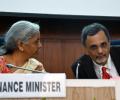
'... and without necessarily calling them Economic Surveys.' 'One should stick to the main focus, which is to give people a good perspective on how the economy is doing.'

Delhi Police ask for 45 documents for opening a restaurant, only 19 for a gun: Survey

Stressing that economic growth will only move upwards, the Reserve Bank of India Governor Shaktikanta Das on Friday pegged the GDP growth rate for the next financial year at 10.5 per cent, though a tad lower than the government's projection of 11 per cent. The projection is in line with the estimates in the Union Budget 2021-22 presented in Parliament earlier this week. The Economic Survey, tabled by the government in Parliament recently, has projected that the economy will grow at 11 per cent, up from an estimated historic decline of 7.7 per cent in 2020-21, on account of the COVID-19 pandemic.
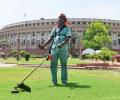
The first part of the session will conclude on February 11. After a month-long recess, the part two of the session would begin from March 14 and conclude on April 8.
In the current fiscal so far, retail inflation stabilised around 5 per cent, while wholesale price-based inflation averaged around 2.9 per cent during April-December.

If as critics point out, the environmental impact assessment study was commissioned only after the auction process got underway with not all the stakeholders getting to know of it, then the government has already compromised the trust it could have enjoyed with Kerala's public including its coastal communities, points out Shyam G Menon.

The Ministry of Statistics and Programme Implementation (Mospi) has started preparations for the eighth Economic Census (EC), which is expected to be formally launched next year, sources told Business Standard, even as the results of the seventh edition are yet to be made public. "Centre has asked states and Union Territories (UTs) to submit requirements for funds and manpower in a bid to start work on the eighth EC. "The states and UTs are required to set up a dedicated unit to conduct the exercise.

Successive plans have allocated less resources to the Railways.
Some of his directives had the Supreme Court judges disclose their assets whereas the row over the discovery of cash from a sitting judge's official residence paved way for inquiry.
.jpg)
The right sequence would be to gradually reduce SLR
The gross tax revenues have touched 65 per cent of the Budget estimates at Rs 17.81 lakh crore during the first eight months of the current fiscal till November, propelled by corporate and personal income tax mop-up, according to the Economic Survey 2022-23 presented in Parliament on Tuesday. The survey, authored by Chief Economic Advisor V Anantha Nageswaran, said the 'substantial reforms' in India's taxation ecosystem post-2014 and policy reforms have removed the distortionary incentives from the economy. Reforms like GST, reduction in corporate taxes, exemption of sovereign wealth funds and pension funds from taxes, and removing Dividend Distribution tax have reduced the tax burden on individuals and businesses.

It also advocated adoption of technology platforms and innovative models.

The government on Monday said it was willing to discuss every issue under rules during the Budget session of Parliament and sought the support of the Opposition in running the proceedings smoothly.

Top on the government's agenda would be getting Parliament's approval to the budgetary proposals and presentation of the budget for the Union Territory of Jammu and Kashmir.

Survey calls for reorienting policies to promote young firms which have the potential to become big, rather than small MSME firms which remain small.

The deficit increased to $ 57.2 billion or 2.1 per cent of gross domestic product (GDP) in 2018-19 as against 1.8 per cent in the previous year.

The session will begin with the address of the President to the joint sitting of the two Houses on Friday morning followed by the presentation of the Union Budget on February 1.

The Budget Session of Parliament will commence on Monday and is scheduled to conclude on April 8 wherein the first part of the session will extend up to February 11, said the Lok Sabha Secretariat on Sunday.

The Commerce and Industry Ministry has circulated a draft Cabinet note for inter-ministerial consultations.

Indian economy is poised to do better on the back of reforms undertaken by the government and is expected to clock a 6.5-7 per cent growth in the remaining part of the decade, Chief Economic Advisor (CEA) V Anantha Nageswaran said on Tuesday. Addressing reporters here after the tabling of the Economic Survey in Parliament by Finance Minister Nirmala Sitharaman, Nageswaran said that by and large, inflation is likely to be "well behaved" in FY2023-24 barring headwinds. "My optimism is that in the coming decade, rest of the decade, the potential GDP growth, without taking into account export potential, because global economy is still rife with uncertainty, the growth rate would be around 6.5 to 7 per cent, rather than between 6 per cent and 6.5 per cent," he said.
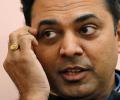
Chief Economic Advisor (CEA) K V Subramanian will be leaving the finance ministry and returning to academia on completion of his three-year term. The government had appointed Subramanian, an ISB Hyderabad professor, as the CEA in December 2018. He had succeeded Arvind Subramanian, who quit the position close to a year ahead of his extended tenure. Subramanian's three-year term would have come up for renewal in December but he decided to return to academia.

Noted economist Arvind Subramanian is favoured as the choice for the government's Chief Economic Advisor (CEA).

It said while Indian IT services companies were the "disruptors" and had created the modern offshoring industry, they are now incumbents, challenged by a host of specialised and niche start-ups that have emerged in the new digital environment.
Alternatively, the government may go in for a five-day session to blunt criticism that it was running away from debates.

The finance minister continues to be backed by the same policy team in charting out the broad strategy as in the few earlier Budgets.

Food subsidy bill rises 20% in April-January

Revenue buoyancy of GST will be key to improve the resource position of both central and state governments.

The fiscal deficit, as per the survey, deteriorated to 5.8 per cent of the GDP as compared to 3.4 per cent for 2018-19 estimated in the interim Budget.

The decline in inflation was broad-based across major commodity groups except housing and fuel and light.

India's share in world tourist inflows was only 0.64 per cent in 2012. It could only attract 6.97 million foreign tourists during 2013.
